
The collapse of Mughal rule in Punjab which was accelerated by Nadir Shah’s & later Abdali’s invasions of India would cause the Multan region of Punjab to drift in to the Afghan (Pashtun) sphere. Fast forward & Nawab Muzaffar Khan Sadozai is Governor of Multan on behalf of the state founded by Ahmad Shah Abdali, the Durrani Empire.
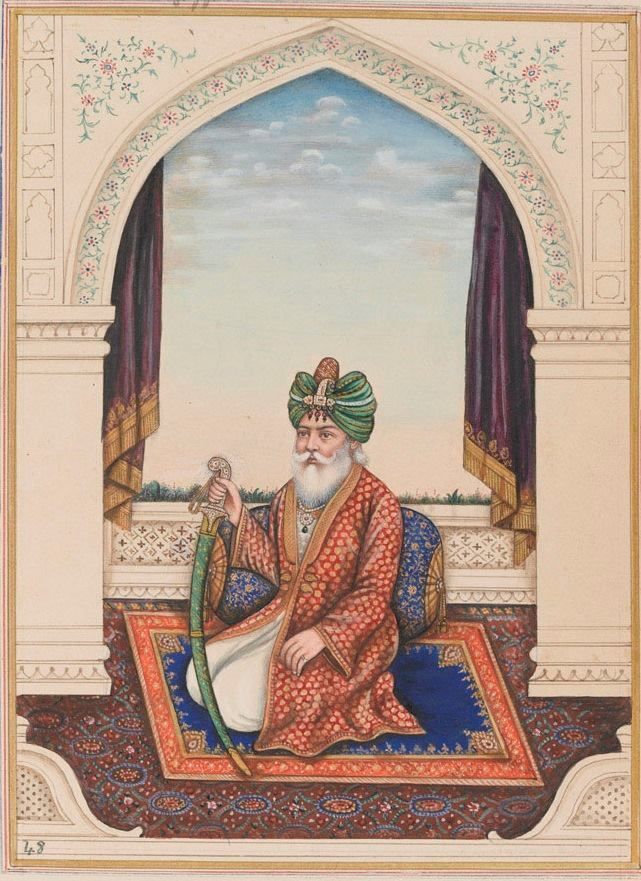
The first meeting between Ranjit Singh & Nawab Muzaffar would be in 1802 when the former set out for Multan on a scouting mission, where Nawab Muzaffar would meet the Maharaja, 30 miles outside of Multan & exchange presents. Four years later after subduing Jhang in 1806, Ranjit would again march out for Multan but the Nawab had no appetite for combat & would get the Maharaja off his case by paying R.s. 70,000. The next year Ranjit Singh would again attack Multan, capturing the city partially, but could not conquer the fort & due to a stalemate an agreement would be concluded giving Ranjit a large sum of money but the amount is not specified by Lepel Griffin [1]
The Nawab was initially installed as a Durrani Governor, but had become more or less independent, so in a desperate bid to save his mini-kingdom, he would request the British to intervene, but the Empire was simply not interested in extending their influence in that region & would thus decline [2]. However, the Sadozai family would get their wish of serving the Colonialists later by collaborating in the 1857 War of Independence against the local resistance forces of heroes such as Rai Ahmad Khan Kharal, but that is for another day.
On February 24th, 1810 Ranjit Singh would conquer the city, but the fort again would prove to be an achilles heel. On 21st March another failed assault was ordered, then again on the 25th of March same thing would occur & the besieged would live to fight another day after a valiant defense of their fort. The stalemate again would compel the Maharaja to raise the siege & take a sum Rs. 2.5 Lakh, 20 war horses & a promise to provide troops in need of war. [3]
It is becoming evident to the readers, that the Multan province at this point was a vassal of the Khalsa Empire. In February 1816 a force was dispatched by Ranjit to collect tribute from Multan, due to a delay on Muzaffar Khan’s part in making payment, & the sheer intensity of the Sikh attack forced the Afghan Nawab to pay his dues. Then in 1817 another force was sent which would fail yet again but a R.s. 10,000 ransom would end things for the time being. According, to Lepel Griffin these small attacks were part of a wider plan to gain strength, while simultaneously keeping the enemy busy. [4]
In January 1818 an army of 18,000 men would be dispatched to capture Multan commanded by Diwan Chand but the Nawab only had 2000 men at his disposal & also did not plan for supplies as he did not foresee a siege, but nonetheless the defense put up was something described by Lepel Griffin “the Sikhs had never before seen”. The bombardment went on till 2nd of June which would open breaches that the Sikh forces would naturally capitalize on to capture Multan. The episode would conclude with Nawab Muzaffar Khan standing with eight of his sons, sword in hand shouting at the Sikhs “Come on like men & let us fall in fair fight.” The rest is history. [5]
Conclusion & Thoughts:
As a Muslim it is tempting to sympathize with the Sadozai cause against the non-Muslims, but for Punjabi Muslims picking between Sikhs & Afghans is a false dilemma, which indirectly relegates the Punjabi Muslim to second tier status playing second fiddle because choosing one or the other suggests that the Punjabi Muslim is a subsidiary group too insignificant to be anything on its own. Secondly, the Punjabi Muslims must ask what exactly were these Afghans doing in Punjab as rulers to begin with & the answer will water away any sympathy whatsoever.
As for addressing the “Saraiki” narrative, which is by no means a defense of Ranjit Singh, it fails on two fronts. Firstly, the idea that after the annexation of Multan by Ranjit Singh they had become subjugated by the Takht (throne)-e-Lahore i.e. Punjabis. As discussed above, Nawab Muzaffar Khan & the Multan province were Khalsa vassals as early as 1806. It’s a different story that Ranjit Singh wanted a more centralized setup over having a dependency.
Secondly, the reader has to understand that the Khalsa Empire itself was composed of eight provinces: Gujrat, Jalandhar, Peshawar, Jammu, Kangra, Kashmir, Lahore & Multan, so even on that account, the comical, fallacious & non-sensical attempt to setup a Punjab vs Multan narrative fall apart. [6] So, even after the “annexation”, Multan remained a province under the Sikh rule. In fact, it was the same British to whom all of today’s “Saraiki” leaders including the Sadozais can thank their good fortunes for the services they provided in 1857 that dissolved Multan as an administrative unit.
Now does this confirm the “Saraiki” accusation that Punjab is a British construct? Regardless of administrative units, Punjab as a cultural organism is a concept that goes back time immemorial with notable mentions as far back as the Mahabharata. Al-Biruni states “After these five rivers have united below Multan at a place called Pancanada.” [7] , which is exactly the same word used in the Farsi version of the text. When was the word Saraiki first mentioned & in what context?
The reader should ask, what exactly makes Nawab Muzaffar Khan a hero for the “Saraikis”? The Nawab’s presence in Punjab was a consquences of Abdali incursions who saw himself as a Pashtun as evidenced by the emancipation of his kin & other Pashtun clans of the area like Tarin, who can trace their wealth back to the Afghan (Pashtun) rule as pointed in the Multan Gazetteer.
To conclude, Multan was a Khalsa vassal even during Nawab Muzaffar’s lifetime, after Multan’s conquest by Sikhs it remained a province & the Sadozai chief viewed his rule as a Pashtun venture. So, the whole reason why this discussion exists is to give South Punjab some kind of distinct “Saraiki” identity, which is unique from the North as a means of people of settler origin exerting their will instead of assimilating, which includes cultural appropriation & the otherization of the indigenous population calling them “abadkaar” (settlers).
Sources:
[1] Ranjit Singh by Lepel Griffin pg. 183
[2] Ranjit Singh by Lepel Griffin pg. 183
[3] Ranjit Singh by Lepel Griffin pg. 184
[4] Ranjit Singh by Lepel Griffin pg. 185
[5] Ranjit Singh by Lepel Griffin pgs. 185-187
[6] Understanding Kashmir & Kashmiris by Christopher Snedden
[7] Alberuni’s India pg. 186


I really appreciate your contributions towards history of Punjab. Can you write about Langah Dynasty of Multan (who were most probably native rulers) as well as chieftains of Pothowar Plateau? Here too Gakhars and Khokhars established independent states (as evident by multiple forts in the region) for centuries.
LikeLike
Inshah Allah i will eventually cover those topics as well. Thanks for reading.
LikeLike
Asalamu alaikum brother,
Just wanted to say reading your articles has really opened my eyes, I wish the pakistani government could promote the same narratives as yourself.
Anyway could you write a blog on the legend of Rai Abdullah Bhatti and if we can somehow prove his existence? Much appreciated brother
LikeLike