

Though only glossed over in school, at least in my time, the 1857 War of Independence is one of the most significant events in the history of Punjab & even wider Pakistan for the simple reason that the elite in today’s Pakistan can trace their lineage back to the forces that prevailed that day, one way or another. Be it institutions or the people governing the populace through these instruments.
While the 1857 Revolt had its heroes like Rai Ahmad Khan Kharal & Shah Abdul Qadir it also had its villains, who played an essential role in undermining the movement by acting as collaborators for the Empire. Now it would be delusional and dishonest to suggest that had Rai Ahmad Khan Kharal and the Punjabi Muslims succeeded in 1857 that it would have been the end of things there because the British Empire and the wider Western Civilization by now were so far ahead from the rest of the world in every facet including warfare that it would have been just a matter of time that Punjab had become part of the British Empire.
The scattered nature of the revolt also does not help. Then the local dynamics or rivalries that were utilized by the Raj to divide & conquer. But this isn’t to say that the Punjabi Muslim rebels did not have any success. Sir John Lawrence was head of Punjab administration who is quoted “all might still be lost if that spirit of unrest which was astir throughout Punjab were once allowed to gain heed.” [1]. He also said that “Had a single leader of ability arisen among them, nay had they followed any other course than they did pursue in many instances, we must have been lost beyond redemption” [2]
To explain why he felt this way, numerous towns in Punjab were captured by these same ragtag Punjabi Muslim tribesmen that took on an Empire upon whom the sun didn’t set with all the firepower in the world to spare. Take for instance Kamalia, the rebels were able to capture it not once, but twice. Harappa was another town where the Raj forces faced defeat.
Even Karl Marx took notice when he remarked “In the Punjab, the spirit of rebellion was forcibly kept down, a mutiny being suppressed at Sealkote (Sialkot), another at Jhelum, and the disaffection of Peshawar successfully checked.” While writing for the New York Daily Tribune on September 1st, 1857. Marx also made a note of when Punjabi Muslim rebels cut off the communication line between Lahore & Multan for 8 days in a separate piece. [3]
However, just because the Revolt was bound to fail doesn’t mean we ignore how things played out & exonerate those who sabotaged it. As I stated earlier, the elite of Pakistan is drawn from this same lot & therefore we the common Punjabis continue to suffer from the aftereffects. Previously, I have written on the Nawabs of Bahawalpur & the general public’s misguided romanticization who don’t consider their role as collaborators in 1857. Today, I shall focus on another family of South Punjab, that of current Foreign Minister of Pakistan, Shah Mahmood Qureshi, the “sajda nashin” of Bahauddin Zakariya shrine and illuminate on the reasons behind their material wealth & political clout.
Qureshi family’s role in 1857:
Lepel Griffin was a British Raj administrator in Punjab who in his 1890 book, Punjab Chiefs Vol 2. writes about the various influential families of the region. On Multan he mentions the Qureshi family & their patriarch Makhdum Shah Mahmud who, “In 1857 Makhdum Shah Mahmud rendered excellent services to the Government. He afforded the Commissioner information of every important occurrence that came to his knowledge”. [4]
“No one in his life ever shares wives, land and mares with others.”
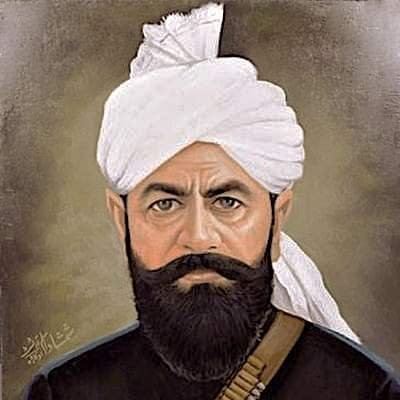
Rai Ahmad Khan Kharal
Now compare this with Rai Ahmad Khan Kharal, who led the Punjabi Muslim tribes successfully in at least five battles according to Denzil Ibbetson, author of the famous and very resourceful book: A Glossary of the Tribes & Castes of the Punjab and North West Frontier Province. A Punjabi dhola (folk song) attests to N.W Elphinstone’s comment that “He (Kharal) was chief of all clans. He had been resisting the previous government. Ranjit Singh avoided confrontation with him and used to bypass his areas” . He also said “Ahmad Khan had been the chief instigator of the movement, his reputation for success in former insurrections was considerable and his influence over the Clans on the Ravi unbounded” [5]
Not only did Shah Makhdum render “excellent services” as according to Lepel, Shah Makhdum “accompanies Colonel Hamilton against the insurgents, took upon himself a portion of the camp duties and protected the baggage on the line of march.” Lepel adds “His (Shah Makhdum) presence on that occasion had a great effect on the rebels, who saw that the most influential man of their own faith was against them.” [6]
Whereas Major F.C. Marsden, Deputy Commisioner Gugera reports on Rai Ahmad that “When I reached Gugera, I found it had been attacked by the powerful clan of Kharal under their old chief, Ahmad Khan, a wealthy, determined old patriarch”. [7]
For his services and betrayal, Shah Makhdum received a present of Rs. 3000, jagir worth Rs. 1780 & 8 wells granted in perpetuity worth Rs. 500 each. He also received a personal gift from the Viceroy called Bhangiawala Bagh in 1860. [8]
In contrast, Rai Ahmad Khan Kharal whom Lieutenant Berkely attempted to buy out by proposing to him “Provide me with horses and men, Rai Ahmad and I will secure a citation for you from London” to which the 80 year old, Kharal tribal chief & Punjabi Muslim hero Rai Ahmad responded “No one in his life ever shares wives, land and mares with others.” [9]
Shah Makhdum was succeeded by his son, Bahawal Baksh, who naturally enjoyed the bounties of his father’s treachery. On top of that he received canal grazing dues in perpetuity. In fact a dress of honour was conferred due to his services during the Afghan war in 1880. Lepel writes “He assisted in collecting camels for transport purposes, and he made the offer of personal services, which, however, were not required” [10]. The younger brother of Shah Makhdum was a “Viceregal Darbari” and also rewarded for his services during the Afghan war & the family’s branch that is settled in Sindh & associated with Ghauspur shrine had a similar story of collaborating & being rewarded jagirs as reward. So, we can establish that its clearly something that runs in the family. [10]
Conclusion:
Fast forward today & the family is leading the charge on carving out a new province out of Punjab, which would simply be interior Sindh 2.0 in the name of “Saraiki” rights which in itself is nothing more than the family’s continual betrayal of Punjab & their hatred towards Punjabi Muslims In fact the mere existence of Punjab reminds them of their treachery, so rebranding it as a “Saraiki region” serves as a restart button . They claim the area has been marginalized by “Punjab”, yet they never bring up distributing their own vast jagirs as a way to mitigate it, which were handed out to them as a prize for being traitors to Punjab & Muslims. In fact we can gauge their sincerity with how these people never miss out on a chance to be in the Parliament regardless of the regime in-charge yet what have they done for the South?
Sajjad Qureshi, the father of Shah Mahmood Qureshi was the first person according to Shafqat Tanvir Mirza to push for the Multani dialect as a distinct language on an electoral platform in 1962 which is quite fitting as its a linguistic classification pioneered by the British Raj civil servants posted in the area, the previous masters of the family. Its also amusing because we are told that Punjab, which as a concept traces its roots back time immemorial is now a colonial construct & that we need to de-colonize Punjab, yet the entire reason your identity exists is due to betrayal of Muslims along with institutions & an elite that are a colonial hangover. Not to mention pushed primarily by people of settler origin.
Sources:
[1] MALIK, S. (1977). 1857 GOGIRA REBELLION IN SOUTHEASTERN PANJAB: A FORGOTTEN CHAPTER OF MUSLIM RESPONSE TO BRITISH RULE IN INDIA. Islamic Studies, 16(2), 65-95. Retrieved July 20, 2020
[2] Punjab and the War of Independence by Dr. Turab ul Hassan Sargana pg. 174
[3] The First Indian War of Independence 1857-1859 by Marx Engels
[4] The Panjab Chiefs by Lepel Griffin pg. 87
[5] Punjab and the War of Independence by Dr Turab ul Hassan Sargana pg. 135
[6] The Panjab Chiefs by Lepel Griffin pg. 88
[7] Punjab and the War of Independence by Dr Turab ul Hassan Sargana pg. 135
[8] The Panjab Chiefs by Lepel Griffin pg. 88
[9] Punjab and the War of Independence by Dr. Turab ul Hassan Sargana pg. 178
[10] The Panjab Chiefs by Lepel Griffin pg. 88

 Punjabi Waseb