

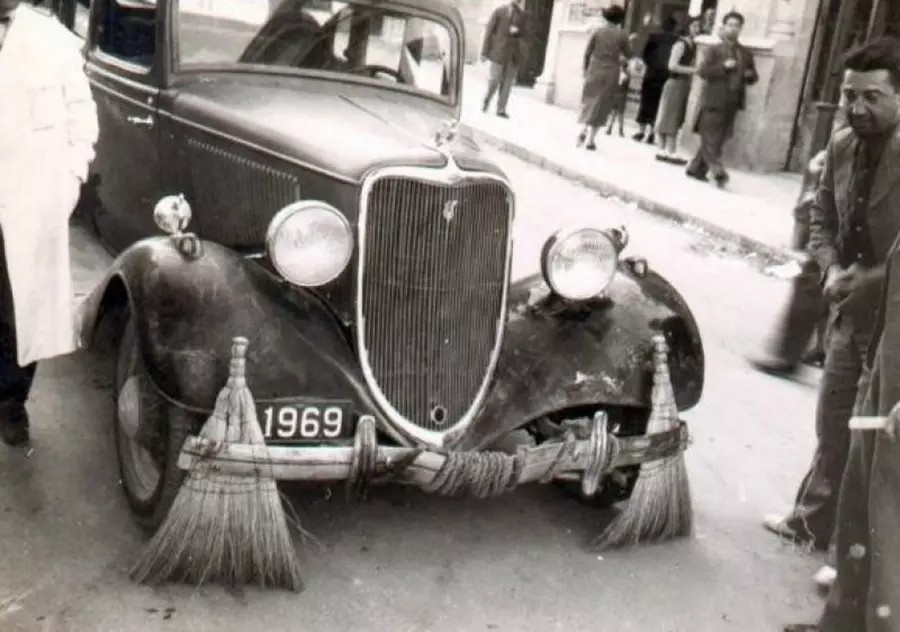
Many of us have seen this on social media, phrased in a celebratory tone and the story goes something like this: the Nawab of Bahawalpur while in London tried to purchase a Rolls Royce, but was turned down because the salesman perceived him as a poor Indian. This caused the Nawab great offense & the next day he appeared with his entourage all dressed up in royal gear and purchased six of these vehicles, however they were to be used for sanitation purposes for his Bahawalpur state. Another version claims that two of those cars were utilized for the same purpose in London, England.
Nonetheless, the idea is always to put the Bahawalpur Nawabs on a pedestal as being some no nonsense stand up folks that really showed the white man who the real boss is! The “royal” factor also plays on the people’s imagination. However, what lies beyond this pretentious feel good moment is a grim reality that no one talks about beyond academic and hobby historian circles, hence the objective of this piece is to challenge the readers to see if they feel the same way about the Nawabs.
From the very beginning the Bahawalpur state were on good terms with the British who guaranteed protection against Ranjit Singh and the Empire did not interfere in the state’s internal affairs either [1], which isn’t to say nor imply that Ranjit Singh was a hero, at least not for Punjabi Muslims, but this relationship set the trajectory as to how the Nawab of Bahawalpur were to act in 1857.
The Bhattis of Bhattiana territory was a vassal state under various empires, who had fended off Colonial advances in the earlier part of the century all on their own. In 1803, the detachment sent to annex Bhattiana were met with a defeat including the demise of the Colonel leading it, which put off the expansion plans until 1810. Despite their defeat & a presence of a large force in their areas, Nawab Zabita Khan encouraged Bhatti raids & plundering and so, a force had to be sent to put down the insurrection in 1818. [2] So, when the fire of rebellion was lit in 1857, the Bhattis rose up in revolt as a chance to recover their homeland.
The Bahawalpur state were neighbors to Bhattiana region, but the question is what role did they play? On May 20th, Haji Muhammad Khan, the Nawab of Bahawalpur at the time received a letter from Superintendent of Sirsa asking for assistance, the Nawab complied by supplying in total 3000 troops to crush the Bhattis in Sirsa, who had mild success by capturing Rohtak. [1]
After the fall of Rai Ahmad Khan Kharal on September 21st, 1857, who lead the revolt at the age of 80, there was a leadership vacuum that could not be filled. While the Punjabi Muslim rebels held out in to the year 1858, without any concrete leadership it was only a matter of time the movement would be stomped out as it did.
The freedom fighters offered Nawab Fateh Muhammad Khan, the leadership of what they claimed were 18,000 men, which he refused instead of stepping up. Sir John Lawrence who headed the Punjab administration comments “Had a single leader of ability arisen among them, nay had they followed any other course than they did pursue in many instances, we must have been lost beyond redemption”[1]
To add insult to injury when the movement was on its last legs in 1858, rebels seeking shelter in Bahawalpur area were seized upon entry by the Nawab’s forces, “every insurgent, who trusting to his promise of protection, had crossed the Sutlej to be seized, and given up to Major Voyle”, remarks John Cave-Browne, an officer at the time tasked with hunting down the rebels [3]. Predictably, the Bahawalpur state served as vassal for the British Empire before being dissolved into Pakistan.
Conclusion:
The objective of this piece is not even to remotely imply that the cause of failure for the 1857 War of Independence was due to Nawab of Bahawalpur collaborating & not stepping up to lead. Maybe things would have turned out the same, most likely the same as the disparity between the West & the rest of the world was too steep at this point. Rather the issue is the baseless romanticizing of the Bahawalpur state, whose existence was hardly a benefit to the people of the region.
Today, the family enjoys perks such as diplomatic passports and is involved in various attempts at restoring autonomy in hopes of maybe able to relive their “glorious” past, which is nothing more than colonial hangover.
Resources:
Books
[1] Punjab & the War of Independence pgs. 94, 174
[2] History of Sirsa Town, pgs. 48 & 49.
Journal
[3] MALIK, S. (1977). 1857 GOGIRA REBELLION IN SOUTHEASTERN PANJAB: A FORGOTTEN CHAPTER OF MUSLIM RESPONSE TO BRITISH RULE IN INDIA. Islamic Studies, 16(2), 65-95

 Punjabi Waseb
[…] lot & therefore we continue to suffer from the aftereffects. Previously, I have written on the Nawabs of Bahawalpur & the misguided romanticization of the general public towards them when we consider their role […]
LikeLike
Sarang Bhai i fully agree with what you have written. Can I just add a little note. I don’t know why nawabs of bahwalpur style themselves abbassi? The nawabs of bahwalpur are Sindhi in origin of daudpota branch of kalhoro tribe. The kalhoros were mentioned as Sindhi jats. It seems a little like inferiority complex adding arab identity. However what is clear is that sindhis punjabis have always had cordial relations not including the fact ivc. Although you are Quite right as making bahwalpur province is colonial hangover as British raj was 1 of worse periods for Asia.
Bahwalpur state was the 3rd richest Muslim state in subcontinent and the only big state that did a lot for Pakistan. Compared to turkic nizam of hyderabad who mostly Employed Arabs and afghans in his state and army. He helped Hindus and was a symbol of Indian Muslims. The did not do anything for. Pakisan region,its not rocket science how his arab afghan army fared. Fact is bahwalpur state was very active on aftermath of ww1 in dealing with issues affecting Muslims and pak region. Through bahwalpur there is a claim on the so called India serai and land in Jerusalem which was paid for by the Nawab.
Through Bahwalpur pak state may have a claim in Holy cities of mecca and medina. E. G. It was from bahwalpur that the long tradition of making and sending the curtains for the kaaba was carried out before end of British rule starting 1946.
LikeLike