
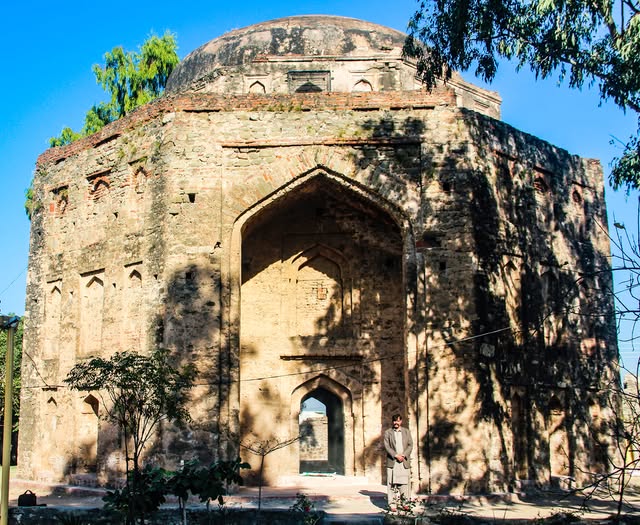
Tomb of Sarang Khan. Image Source: Taimoor Rasheed Gakhar on Facebook.
Recently, I came across a post celebrating the installation of a statue of the one Sarang Khan Gakhar, which reminded me that after half a decade of blogging I have never written a post on the man whose name I have appropriated to be my pen name.
While, I am not a fan of statues for religious reasons, a plaque would have been sufficient, but at this point in our people’s journey towards building an ethnic consciousness, if this helps in some positive way, then so be it, but for now. It is most definitely an upgrade from having one of Sher Shah Suri or Ranjit Singh.
Collective memory is in my opinion the most essential part of a nation’s identity, I will dare to argue even more so than language. Not that its a competition. Collective memory is a set of historical lessons and mission statements, that then serve as a moral compass and even play a role in decision making. The Scottish people in UK, who are in an even worse position than Punjabi Muslims in terms of language, where less than 2% of their population as of 2022 speaks the Scottish Gaelic language have retained their sense of nationhood. Symbolism also plays a role in invoking & retaining the collective memory. This article will demonstrate this point in the Punjabi Muslim context:
For starters Sarang Khan was not a Sultan, because I see this all the time online among other cringe such as “Khokhar empire” and what not. Sultan would imply ruling a state, while Sarang’s domain was not even a vassal state of which he was King. Sarang was a cheiftain of the Gakhar tribe, subservient to the Mughals, who owned the lands between rivers of Indus and Jhelum [1] Even before Mughals, Gakhars were locked-in a civil war with Janjuas, so it isnt as if Mughals reduced them to a tribal principality. There isn’t any evidence (happy to be corrected) to suggest that Sarang even ruled a tribe other than his own, so the word “Sultan” is doing a lot of heavy lifting and is akin to the exaggerations that we mock our neighbors for.
The Gakhars had been on friendly terms with the Mughals since the arrival of Babur and after Sher Shah Suri overthrew Humayun and declared himself ruler of India after quietly building strength for four decades demanded Gakhar submission. The strategic nature of Gakhar residence demanded their obedience to prevent future attacks to the newly formed Suri state’s western borders. The invitation to acknowledge Sher Shah through an envoy was responded by Sarang Khan in the form of sending back a bow, arrow and a lion cub (symbolism) implying that they are the masters of war. This naturally irritated Sher Shah Suri, who promised to deliver such a blow with a dagger that it will remain in their hearts forever. [2]
“Be at your ease. By the grace of God, I will thrust such a wedge in the hearts of you all that till the day of Resurrection no man shall be able to pull it out” [3]
The reason for Sarang’s decision was the loyalty he felt towards Babur and now Humayun due to their favors towards him. The fighting took place in which Sher Shah used Janjuas against Gakhars just as Babur himself previously played on this centuries old rivalry before establishing himself in India. Sarang Khan would be captured and given the punishment of being skinned alive and his daughter given to one of Sher Shah Suri’s Generals. The campaign culminated with building the Rohtas fort to keep the Gakhars in-check but not without 50,000 troops in Punjab. Another one of Suri’s Generals, Haibat Khan Niazi was left in-charge of the Rohtas Fort. [4] Very important to note that former Prime Minister, Imran Khan claims descent from this very Haibat Khan, which explains a lot of his ethnically loaded rhetoric and favoritism.
The Gakhar story doesn’t end there though because after Sher Shah’s death, his son Islam Shah would fall out with the Niazis, who would then seek and get refuge with the same Gakhars they’d oppressed less than a century ago. [5] The Gakhars in-fact were never fully subdued by Suris despite the brutality inflicted on their leader as Islam Shah would order to build 5 more forts to keep them and other Hill Rajas in the area in-check. [6] Not much to discuss about the Suri rulers post-Islam Shah and eventually Humayun would re-conquer India and re-establish the Mughal Empire retaining many of the great administrative measures introduced by Sher Shah Suri in his absence.
Personal Reflections & some notes on Sher Shah Suri:
As mentioned above, Sarang Khan was a mere cheiftain of Gakhars, not even a King, which implies mastery over multiple tribes or nations, let alone an Emperor. However, his symbolic response to Sher Shah, the savagery inflicted on Sarang in response. Not to mention the Gakhars never being properly subdued by Suris despite having more soldiers at their disposal for Rohtas fort than there were Gakhars. This is in line with the other Punjabi Muslim heroes that I have written about over the years on my blog and the common theme here is the delusional self-belief (positive) to take on something bigger than you and be convinced that you will actually succeed.
Chaudhry Rahmat Ali even pulled it off by single handedly changing the narrative from autonomy within a greater India to an independent state before everyone else jumped on the wagon and appropriated the idea of Pakistan for themselves. Even prevented him from living and being buried in that same country.
Other instances are the example of Jasrath who confronted Timur with just 2000 people from his Khokhar kin. Ahmad Kharral with his rag tag Kharrals and Wattus took on a whole empire and won multiple battles. However, their downfall was always a lack of unity and sense of nationhood which prevented broader mobilization. It’s amazing how our people decry anything related to celebrating our culture or identity, but turn around to sing praises for other Muslim ethnic groups who achieved the things they did a large part due to their group cohesion.
Now, why is it that I insist on calling Sarang Khan, who is in all honesty a footnote in broader history of the region a hero over someone of the stature and achievements of Sher Shah Suri? Does it stem from an irrational pride in ethnicity? But I just called Sarang a footnote a couple lines back?
The real question is what even qualifies Sher Shah Suri to be held in such high regards by Muslims outside his ethnicity? To be clear, the moral compass here isn’t local or foreign. For instance, Mahmud Ghaznavi’s invasions opened the gates for Islam allowing for Sufi preachers to then setup shop and convert the locals. This warrants praise! Same thing with Muhammad Bin Qasim’s campaigns in Sindh and southern Punjab.
Prophet Muhammad SAW said that actions are to be judged by their intentions. Tarikh-i-Sher Shahi’s author, Abbas Sarwani stressed on portraying Sher Shah’s state as the epitome of Afghan ( = Pashtun) unity. [7] Sher Shah also ensured his soldiery was almost exclusively from his ethnicity and to ensure that recruitment officers were dispatched to all corners of India’s Pashtun communities. [8] It’s stuff like this which lead to Sarwani’s aforementioned conclusion as the state Suri came to found was meant to reinstate Pashtun rule in India which was ended by Mughals when they uprooted Lodhis.
Lastly, one of Sher Shah’s dying wishes was to create a Pashtun ethnic corridor, which would naturally involve displacing local Punjabi tribes in order to secure the Western front of his state. [9] We see this obsession with diluting demographics of neighboring communities even today, whether its Pakistan and especially in Afghanistan. Anyways, the intentions become clear and so is the conclusion, which is that whatever Sher Shah Suri did was for the benefit of his kin and nothing else and he is a hero for them and them alone.
Finally, Sarang Khan’s story serves as a lesson for Punjabi Muslims, which have become a recurring theme (collective memory) on this blog revolving around a lack of unity, fighting amongst each other (biradrism) at the cost of allowing outsiders to take root and blindly accepting popular narratives set by our intellectually bankrupt elite.
Many people in Punjabi revivalist and adjacent circles tend to disparage Allama Iqbal, but he was definitely on to something when he said this about his Punjabi Muslims:
Tehqeeq ki bazi ho tau shirkat nahin karta
Ho khail mureedi ka tau karta hai bohat jald
Citations:
- Punjab under Great Mughals, pg 24.
- Punjab under Great Mughals, pg. 24
- Sher Shah Suri: Emperor of India, pg. 44
- Punjab under Great Mughals, pgs. 24-25
- Punjab under Great Mughals, pgs. 26
- Punjab under Great Mughals, pgs. 27
- Naukar Rajput Sepoy, pg. 37
- Naukar Rajput Sepoy, pg. 39
- Sher Shah and His Times, pg. 273
Image source:
https://www.facebook.com/groups/Archaeology.Prehistoric/posts/1243830952432778

 Punjabi Waseb
Good post, keep up the work.
However, one thing I would like to point out about Punjabi Muslim historians online, including you, is that none of you focus on the 15th century Punjabi-led Sayyid dynasty. Although not part of recent history, there is overwhelming evidence in the contemporary sources that link them to Punjab. I would even go as far as saying they achieved Punjabi Muslim ethnogenesis for a short while under Sultan Khizr Khan.
Khizr Khan established the only native Indic Muslim rule over Delhi in history (excluding Khusrao Khan before Tughlaqs). He united Punjab under a Punjabi Muslim rule centuries before Adina, created a Punjabi-dominated military and administration, controlled a territory far greater than Jasrat could ever imagine, stretching from Thatta in Sindh to Kannauj in Uttar Pradesh with all lands in between. His family even ruled the neighboring Jaunpur Sultanate.
Instead, you focus on Jasrath Khokhar, who undoubtedly was a brave tribal chieftain, but at the end of the day, that’s all he was, a chieftain. His invasions of central Punjab directly led to the decline of the Sayyids and the rise of the Afghan Lodi dynasty. He could not even produce a single able descendant and Khokhar domination was ended by the same Lodis, meaning Punjabis “lost” in both scenarios here.
Mentioning random chieftains is not going to help our cause of unity overall, we need to promote figures like Khizr and Adina who looked beyond tribal boundaries.
I am not saying one figure should be preferred over the other, but the LEAST you could do is give Khizr some attention. That’s all I have to say. You can check out my analysis on Reddit regarding the Sayyid dynasty with citations (u/AgentWolf667, pinned post).
LikeLike